Showing posts with label infrastructure. Show all posts

Monday, 31 October 2011

14 : Exemplars

Structural principles such as repetition evoke a sense of movement within a design.  I am inspired by the use of materials and spatial arrangements of these projects:

Centre d’Examen du Permis / a+ Samuel Delmas / France

Puerta Umbría High Speed Rail Station / Rafael de La-Hoz Arquitectos / Spain

Infostructure / Manifesto / London

Infostructure / Manifesto / London
BA_LIK / Vallo Sadovsky Architects / Slovakia

Temporary Hotel / IAA Architects

Flederhaus / Heri & Salli / Vienna, Austria

Cadiz Temporary Pavilion / Breathnach Donnellan with EASA Participants / Spain

Temporary Art Pavillion / 4F-K

Temporary Art Pavillion / 4F-K

Temporary Art Pavillion / 4F-K

Design Miami Tent / Moorhead & Moorhead / Miami

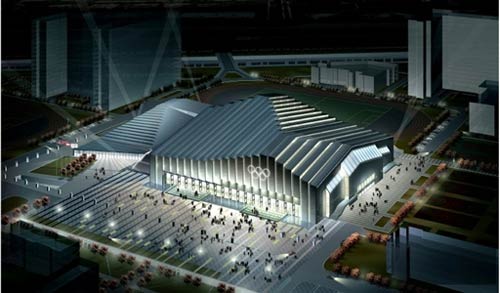
China Agricultural University Gymnasium

China Agricultural University Gymnasium

China Agricultural University Gymnasium


Friday, 28 October 2011

13 : Split Personality

Over the past few weeks I have been establishing a portfolio and I stumbled across an old project I did named 'split personality'.. which was a convertible hotel/office space which catered for students, as they usually hold the characteristic of having two personalities.. one for study and one when they relax.  I suppose this is true for other profession, namely politicians.  They have their public professional persona, and then they have their home personal life... I suppose these lines are beginning to blur with the increased use of social media (Twitter updates 24/7)... but the split will remain..

Here are some of my explorations about this idea:


Tuesday, 18 October 2011

11 : Exemplar : A New Infrasturcture

I like looking at competition panels to gains some inspiration on how to display my panels and the best images to use to convey the right information.. I happen to find a competition which related to new infrastructure in Los Angeles here

Some of my favourite images / projects are displayed below:
1) Glocalizing Los Angeles : The physical separations between places of work and play have become outdated and burdensome. Meanwhile the divide between commercial, residential, agricultural, and manufacturing zones have become so exaggerated that the infrastructures needed to connect and sustain them crumble in lack of upkeep and congestion.

2) Modular Diffusion : In a car, the passenger can go from any given point to another in one continuous trip. To achieve this level of mobility in tandem with an increase in roadway capacity, we introduce a mass transit system based upon a Modular Transit Vehicle (MTV for short). This modular system would allow passengers to (1) board from a wide range of street stops, (2) travel along the freeway, and (3) take the freeway exit closest to the destination drop passengers off there, all in one ride.
3) Interstate 10 : 
4) 

Monday, 17 October 2011

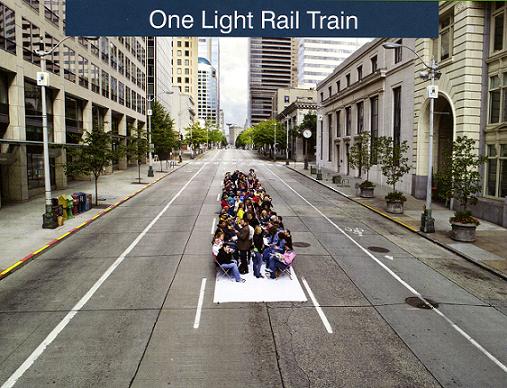
11 : Development : Light Rail


Ok so instead of just posting more light rail examples, i printed out the pictures and drew them instead - this time adding what I wanted to do... I've that in order for me to be the most time efficient with this project, I will only make minor adjustments to a standard light rail design (for example - keep overall 'shell' dimensions the same but adjust interior for adjustable seating / bicycle racks / larger windows / expanding doors etc) and then focus on the design of the woden 'depot' focusing on after hours usage... and how the design of the light rail system can be utilised to provide a public function area... within a 'pavilion' type structure... of which I have yet to design......

I have no idea how I'm going to model this - maybe sketchup?? - I will test it out once I have a solid design? Otherwise I could always do line drawings in cad, and pretty them up in illustrator - similar to BIG Architects graphics. Anyway, here are my sketches for today..


I aim to have a storyboard of my panels by the end of the week so then I will know the exact drawings I need - fingers crossed I can actually pull this off!

Something to leave you with for tonight...

11 : Development : 24-Hour Needs Analysis

So I've gone back a bit towards what I was planning to do along - with a 24-hour needs analysis of how the train is used by the people throughout the day...

Here are some sketchy diagrams I did this morning..


Tuesday, 11 October 2011

10 : Reading : Transport for Suburbia

My intelligent, urban designer friend from Melbourne, recommended this book Transport For Suburbia - Beyond the Automobile Age, by Paul Mees,  as it compares and discusses suburban transport systems in a variety of international cities (including Canberra).


The Canberra plan had one overriding objective, to eliminate traffic congestion.  This was to be achieved by restricting employment in the city and centre and providing an extensive network of freeways.  Canberra was laid out as a Y-shaped ‘linear city’ ... and one intended to allow a ‘balanced’ transport system incorporating a bus rapid transit connection between major centres.  The proposed busway was never built, but most of the freeways were, and Canberra has become a paradigm of autopia, albeit one with an urban form that would make it feasible to retro-fit a public transport system. (Mees, 2010, Page 44).

Monday, 10 October 2011

10 : Development : Possible Route

Using the existing infrastructure maps, with overlays of the low socio-economic areas, I have shown very simply the answers to my questions:
  • Where do the people who rely to public transport live?
  • Where are these people going?
  • Other places of interest / extensions of the line.
Maybe this is just the architect in me, but I the shades of grey are much nicer and less harsh then all that colour from earlier today.


I will attempt to settle on a distinctive route tomorrow so that I can begin developing the light rail in more detail.  I still need a solid brief and imagery by Friday!!

Also, I need to reminding myself than just providing a light rail is not enough... it is only one form of mobility, and it is not a architectural entity either. Perhaps I will refer back to my 'visual thesaurus' I created a few weeks ago for inspiration on how the contents of my light rail can also reinforce the 'mobile' idea.

10 : Research : Existing Public Transport

Below is a couple of map overlays with the existing key bus routes and bicycle pathways, that the light rail will possibly 'support' and then maybe eventually (one day) replace.  This will be used towards my justification as to where my light rail system should be situation.


Saturday, 8 October 2011

10 : Research : Existing Infrastructure

I found a great website today which displays the current bike and walk routes in Canberra and in the outer suburbs, might come in useful when trying to link existing infrastructure to the new.


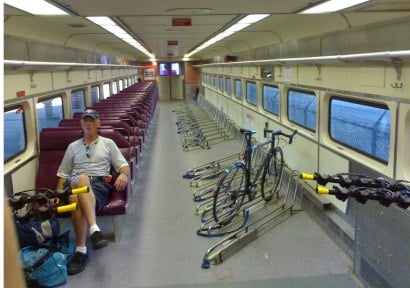
10 : Research : Bikes on Trains

Canberra is trying its best to increase bike usage in the suburbs, and in and around the city.  Here are a few examples of how bikes can be transported directly onto the trains in various other cities:

Stuttgart to Degerloch Zahnradbahn in Germany

Boston, USA


Tuesday, 4 October 2011

10 : Development : Concepts

A few days ago I was chatting with a good friend of mine about my project.  He understood my frustration, so he started just putting forward some crazy ideas which may actually be applicable to the project.  After we spoke I began sketching a few of the concepts and to begin 'testing' some of these ideas.  I'm scared it's too late for me to change my direction, but I think in this way I will be able to develop a better concept.

As with all of this, my justification as to its relevance towards a parliamentary issue still needs to be addressed.


Tuesday, 27 September 2011

09 : Research : Time-Based Architecture

Following on from the reading, here are a few exemplars of time-based Architecture:

Cedric Price Potteries Thinkbelt Project (1964) - This theoretical project was a reaction against the elitist university institutions (which Price believed kept education separate from the masses) and the loss of skilled manufacturing workers/developers through the ‘Brain Drain’ and de-industrialisation of the post-war UK. Price proposed a new type of science and technology teaching institution. The ‘Potteries thinkbelt’ was a series of interconnected faculties and student housing which was linked through the existing road and rail networks (which were underused at the time). The Rail connections not only acted as a link between sites but also acted a teaching rooms, labs and workshops. This was achieved by having container styled teaching units which could be lifted by cranes at ‘transfer’ area onto or on a train depending on the requirements of the institution. Price believed that the creation of such an institution would create employment and innovation in the area and thus aid a better quality of life in the North Staordshire Area.

Archigram 'Walking City' proposed building massive mobile robotic structures, with their own intelligence, that could freely roam the world, moving to wherever their resources or manufacturing abilities were needed. Various walking cities could interconnect with each other to form larger 'walking metropolises' when needed, and then disperse when their concentrated power was no longer necessary. Individual buildings or structures could also be mobile, moving wherever their owner wanted or needs dictated.


These are both theoretical examples, but they still provide a great source of inspiration.

Thursday, 22 September 2011

08 : Research : Bilbao

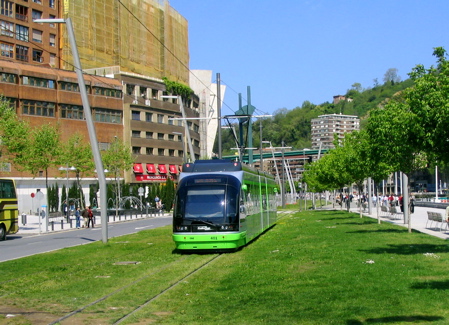
I seem to have developed some sort of condition where I talk about this project to almost anyone that will listen.  This became particularly apparent in Melbourne last weekend, where I met up with two lovely friends of mine (who both happen to be student architects) and gave me a couple of ideas.  As it happens, they traveled around Europe together last year, and they mentioned the light rail system in Bilbao, Spain is really interesting.  So I've done a bit of research into what they were talking about about.


Bilbao developed a new tramming system called 'EuskoTran' and was developed to encourage urban revitalisation.  According to Euskotran suburban trains, the metro and the tramway currently form three essential pillars for the development and revitalisation of Bilbao as a modern city. "After many years went the tram has been rediscovered as an ideal alternative for the future. Quite a paradox for a means of transport unfairly branded as an anachronism and taken out of service during the 50s and 60s in cities which gave their streets and avenues over to private cars. Today, the Tramway is the alternative to pollution-generating forms of transport in city centres. Surface transport which does not need large infrastructures or heavy investment costs. Transport which travels the streets along reserved spaces or in company with other vehicles. Without limits, because its versatility enables it to adapt to any type of urban surface, be it tarmac, paving stones, stone, sand or grass...
These are the most significant advantages of the Tramway, although the economic benefits that this system brings to a city are no less important: it improves access to cities with resulting savings in time and fuel costs, and strengthens the development of cores of commercial activity. The Tramway thus becomes a driving force for a city‚s urban and social transformation."