Showing posts with label strategy. Show all posts

Tuesday, 1 November 2011

14 : Final : Spatial Arrangements


Daytime circulation
Night-time Circulation

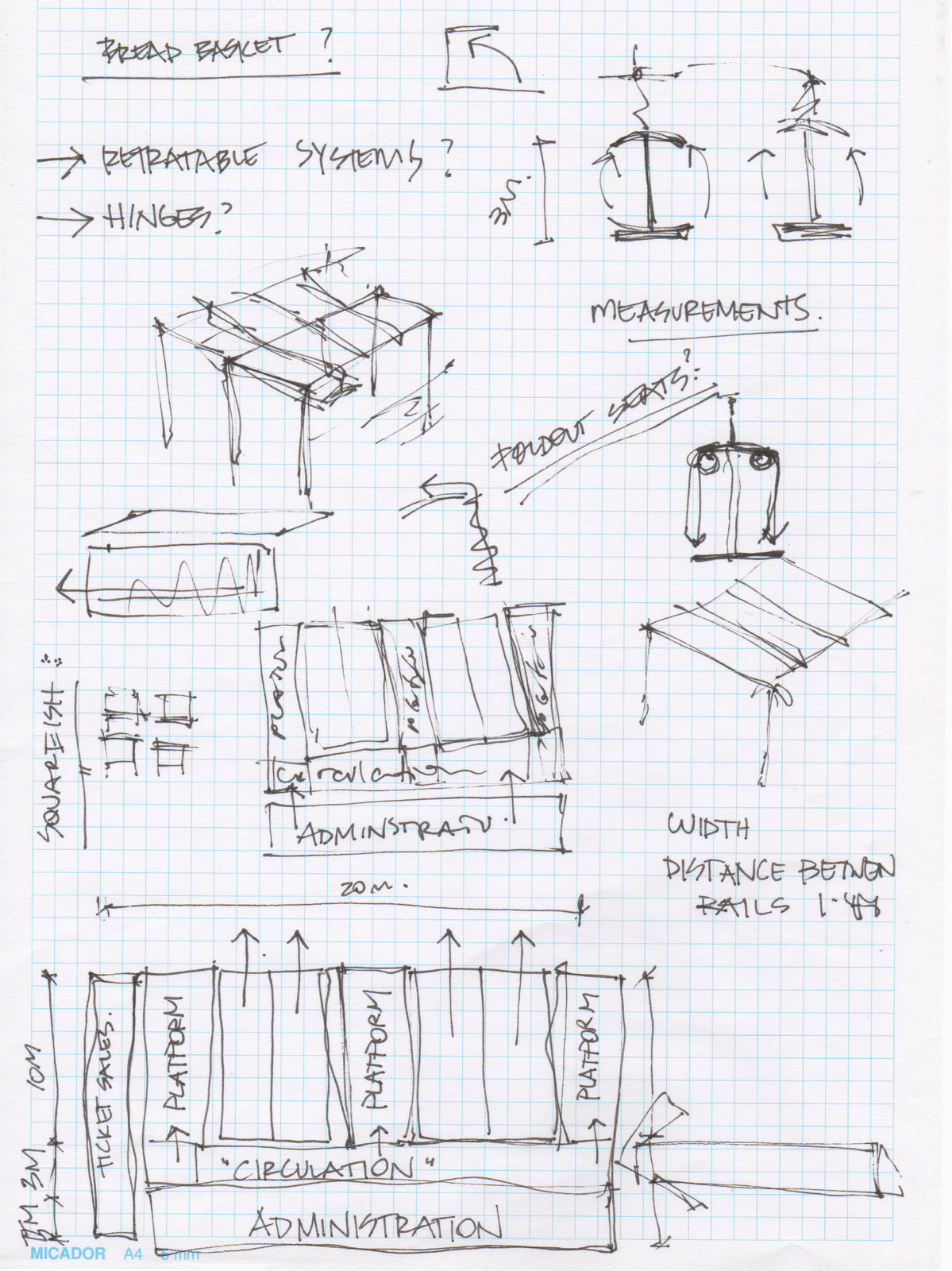
Once I had drawn this image I could see in my mind the whole project.  This image was definitely a turning point when I realized that I could change peoples orientation.  I look forward to diagramming this clearly in my panels.


Friday, 28 October 2011

13 : Lecture

Today's lecture was pretty much a summary of the semester, but if there is one thing I have learned from this lecture series it would be this:


Ira Glass on Storytelling from David Shiyang Liu on Vimeo.


Tuesday, 25 October 2011

12 : Programming 1

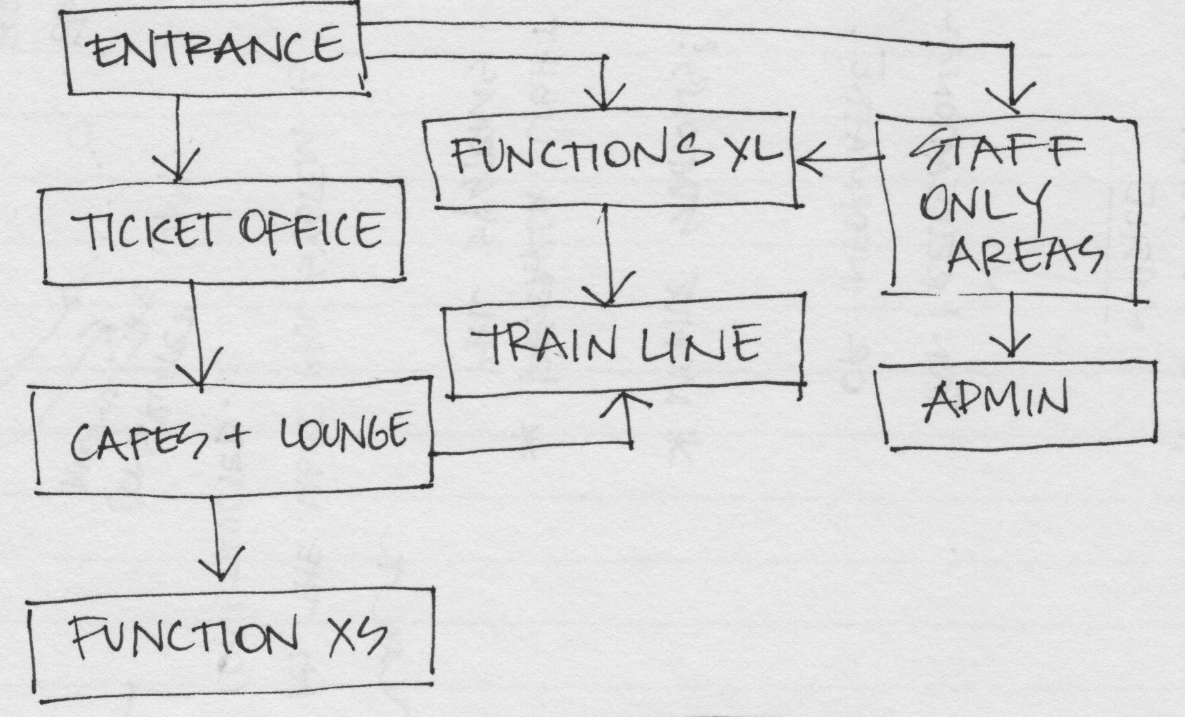
I experimented with some more programming configurations, based on the basic circulation I was trying to achieve as proposed in the tutorial last Friday.  I like having the train line as the 'spine' and the programming expanding from up and above the train line.


Monday, 24 October 2011

12 : Final Design Brief

My design brief has been a bit all over the place, just a whole lot of buzzwords like 'design for dissaembly', 'mobility of people' etc.. so I've written a more extensive brief which address each criteria, just so that I can stay on track over the next two weeks.  All of these criteria answer the questions in my lecture notes found in 07 : Lecture

INFRASTRUCTURE
  • STRATEGY: Woden Valley Depot is supported by various existing systems such as extensive cycle routes, the Westfield Woden bus interchange and Athllon Drive which connect Woden town centre to Tuggeranong.  On an urban scale, the depot is located directly opposite the Westfield shopping centre and town centre which is a central access point for residents in both east and west locations.
  • LOGISTICS: The light rail carriages itself become parts of the circulation of the station.  The structure of the depot allows for a variety of configurations and is designed to a grid system which allows the light rail carriages to line up and connect to form these integrated corridors between the permanent structure and the 'mobile' carriages.
 TECTONIC RESOLUTION
  • PURPOSE AND FUNCTION: To simplify the built form for the presentation, I will use a basic greyscale format for general information and colour where necessary.  I will use an exploded diagram to demonstrate the three structural elements of the Woden Valley Depot, The internal steel framing, backlit skin of perforated steel as cladding and concrete as overall structural base.
  • CIRCULATION AND ACCESS: axonometic floor plans will be used to help illustrate how users move from one for to another, through the use of elevators, stairs and ramps.
  • STRUCTURAL / OPERATIONAL: I will endeavor to display a variety of possible operational outcomes, such as displaying simple diagrams with convey how the structure will react and move in relation to the people who are using the space.
 POETIC RESOLUTION
  • PRESENCE AND IDENTITY: I will present my proposal in a variety of scales.  On a ACT scale, on a Woden Valley scale and from the user perspective.  This will allow me to show how my architectural entity is integrated with the existing context.
  • USER EXPERIENCE: My whole panel will be based on how a variety of people interact with the light rail system over a 24 hours period.  This project diagrams on how the interior spaces of the light rail cater for a variety of needs during the day, as well as how the depot is activated at night time for public forum events.
  • AESTHETIC RIGOR: As with all of my projects, I take a lot of pride in how I communicate my ideas.  I have decided to do one continuous landscape panel, possibly equivalent to 2 x A2 panels which will feature a train line down the centre of the panel, explaining the different stops with icons the represent the needs of that particular area.  It will also include maps of existing cycle/bus routes.  Above the train line with be images/sketches/plans of the light rail carriages.. and then below will have images/sketches/plans/diagrams of the Woden Valley Depot.

Monday, 17 October 2011

11 : Development : 24-Hour Needs Analysis

So I've gone back a bit towards what I was planning to do along - with a 24-hour needs analysis of how the train is used by the people throughout the day...

Here are some sketchy diagrams I did this morning..


11 : Brainstorm

Last night I was feeling quite overwhelmed, so I called my amazing urban designer, who has become quite the mentor these days, for some direction.

Together we went over some ideas.. some crazy, some boring... some completely unrealistic...

I know that creating a trainline itself is not an 'architectural entity' - but I like that idea for some reason.. so perhaps it can still be utilised somehow... After the chat I decided that maybe instead of focusing on a station... I could focus on where these trains go afterhours...

so during the day the interiors are movable... adapatable so people bring their bicycles on board for longer distances.. and then during the day, seating can be provided for shoppers / seniors / general recreation activities... and then at night time all the carriages can retreat to a 'depot' in Woden Valley for a open public arena, like a public forum, concert hall, night club..... Here are few sketches which eventually led to this point.


In one of the lecture Yasu said that our 'architectural entity needs to assist people to:
-debate political/social/cultural issues
-take actions
-do so through mobile means
-assist the constitutes of A.C.T.

Sunday, 16 October 2011

11 : Tutorial

During the Tutorial, I spoke to Jane about focusing on the Tuggeranong area as a regional place of interest to focus on.  Feedback was that realistically, it wouldn't be liable for a light rail system would extend that far.  So we decided that it would be best to focus on Woden instead, as it is the first major residential area outside of Canberra, as well as being central to the international embassies and government buildings.


Monday, 10 October 2011

10 : Development : Possible Route

Using the existing infrastructure maps, with overlays of the low socio-economic areas, I have shown very simply the answers to my questions:
  • Where do the people who rely to public transport live?
  • Where are these people going?
  • Other places of interest / extensions of the line.
Maybe this is just the architect in me, but I the shades of grey are much nicer and less harsh then all that colour from earlier today.


I will attempt to settle on a distinctive route tomorrow so that I can begin developing the light rail in more detail.  I still need a solid brief and imagery by Friday!!

Also, I need to reminding myself than just providing a light rail is not enough... it is only one form of mobility, and it is not a architectural entity either. Perhaps I will refer back to my 'visual thesaurus' I created a few weeks ago for inspiration on how the contents of my light rail can also reinforce the 'mobile' idea.

Tuesday, 4 October 2011

10 : Development : Concepts

A few days ago I was chatting with a good friend of mine about my project.  He understood my frustration, so he started just putting forward some crazy ideas which may actually be applicable to the project.  After we spoke I began sketching a few of the concepts and to begin 'testing' some of these ideas.  I'm scared it's too late for me to change my direction, but I think in this way I will be able to develop a better concept.

As with all of this, my justification as to its relevance towards a parliamentary issue still needs to be addressed.


Tuesday, 27 September 2011

09 : Research : Time-Based Architecture

Following on from the reading, here are a few exemplars of time-based Architecture:

Cedric Price Potteries Thinkbelt Project (1964) - This theoretical project was a reaction against the elitist university institutions (which Price believed kept education separate from the masses) and the loss of skilled manufacturing workers/developers through the ‘Brain Drain’ and de-industrialisation of the post-war UK. Price proposed a new type of science and technology teaching institution. The ‘Potteries thinkbelt’ was a series of interconnected faculties and student housing which was linked through the existing road and rail networks (which were underused at the time). The Rail connections not only acted as a link between sites but also acted a teaching rooms, labs and workshops. This was achieved by having container styled teaching units which could be lifted by cranes at ‘transfer’ area onto or on a train depending on the requirements of the institution. Price believed that the creation of such an institution would create employment and innovation in the area and thus aid a better quality of life in the North Staordshire Area.

Archigram 'Walking City' proposed building massive mobile robotic structures, with their own intelligence, that could freely roam the world, moving to wherever their resources or manufacturing abilities were needed. Various walking cities could interconnect with each other to form larger 'walking metropolises' when needed, and then disperse when their concentrated power was no longer necessary. Individual buildings or structures could also be mobile, moving wherever their owner wanted or needs dictated.


These are both theoretical examples, but they still provide a great source of inspiration.

Thursday, 22 September 2011

08 : Research : Bilbao

I seem to have developed some sort of condition where I talk about this project to almost anyone that will listen.  This became particularly apparent in Melbourne last weekend, where I met up with two lovely friends of mine (who both happen to be student architects) and gave me a couple of ideas.  As it happens, they traveled around Europe together last year, and they mentioned the light rail system in Bilbao, Spain is really interesting.  So I've done a bit of research into what they were talking about about.


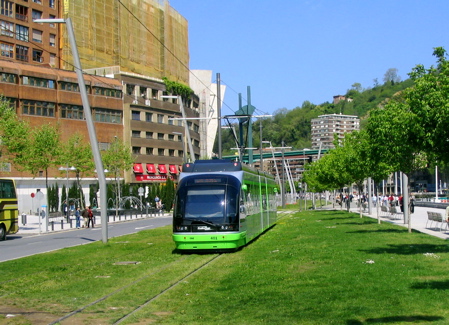
Bilbao developed a new tramming system called 'EuskoTran' and was developed to encourage urban revitalisation.  According to Euskotran suburban trains, the metro and the tramway currently form three essential pillars for the development and revitalisation of Bilbao as a modern city. "After many years went the tram has been rediscovered as an ideal alternative for the future. Quite a paradox for a means of transport unfairly branded as an anachronism and taken out of service during the 50s and 60s in cities which gave their streets and avenues over to private cars. Today, the Tramway is the alternative to pollution-generating forms of transport in city centres. Surface transport which does not need large infrastructures or heavy investment costs. Transport which travels the streets along reserved spaces or in company with other vehicles. Without limits, because its versatility enables it to adapt to any type of urban surface, be it tarmac, paving stones, stone, sand or grass...
These are the most significant advantages of the Tramway, although the economic benefits that this system brings to a city are no less important: it improves access to cities with resulting savings in time and fuel costs, and strengthens the development of cores of commercial activity. The Tramway thus becomes a driving force for a city‚s urban and social transformation."


Friday, 16 September 2011

08 : Lecture

This lecture described a 'new' way to understand sustainability.  Cradle-to-cradle design is something I researched in Collaborative Design last semester, and I particularly the examples shown in todays lecture.


I quite like this Quadror idea and I think having a simple element which is assembled by the user.  A video by Quadror is shown below:

Thursday, 8 September 2011

06 : Individual Assignment

As I understand, the purpose for the rest of the assignment, is build upon the 'strategy' at our interim presentation and create an architectural entity which is to replace and/or support one of more specific function the parliament house currently provide.

Slightly confusing... but upon reflection of our strategy, I've tried to break this down into some sort of concept to give me a bit of direction for the rest of semester.


Wednesday, 31 August 2011

05 : Interim : Country

This is the base version of my 3D Australian graphic:


Analysis about reasons and future predictions in each state / country :


05 : Interim : Panels

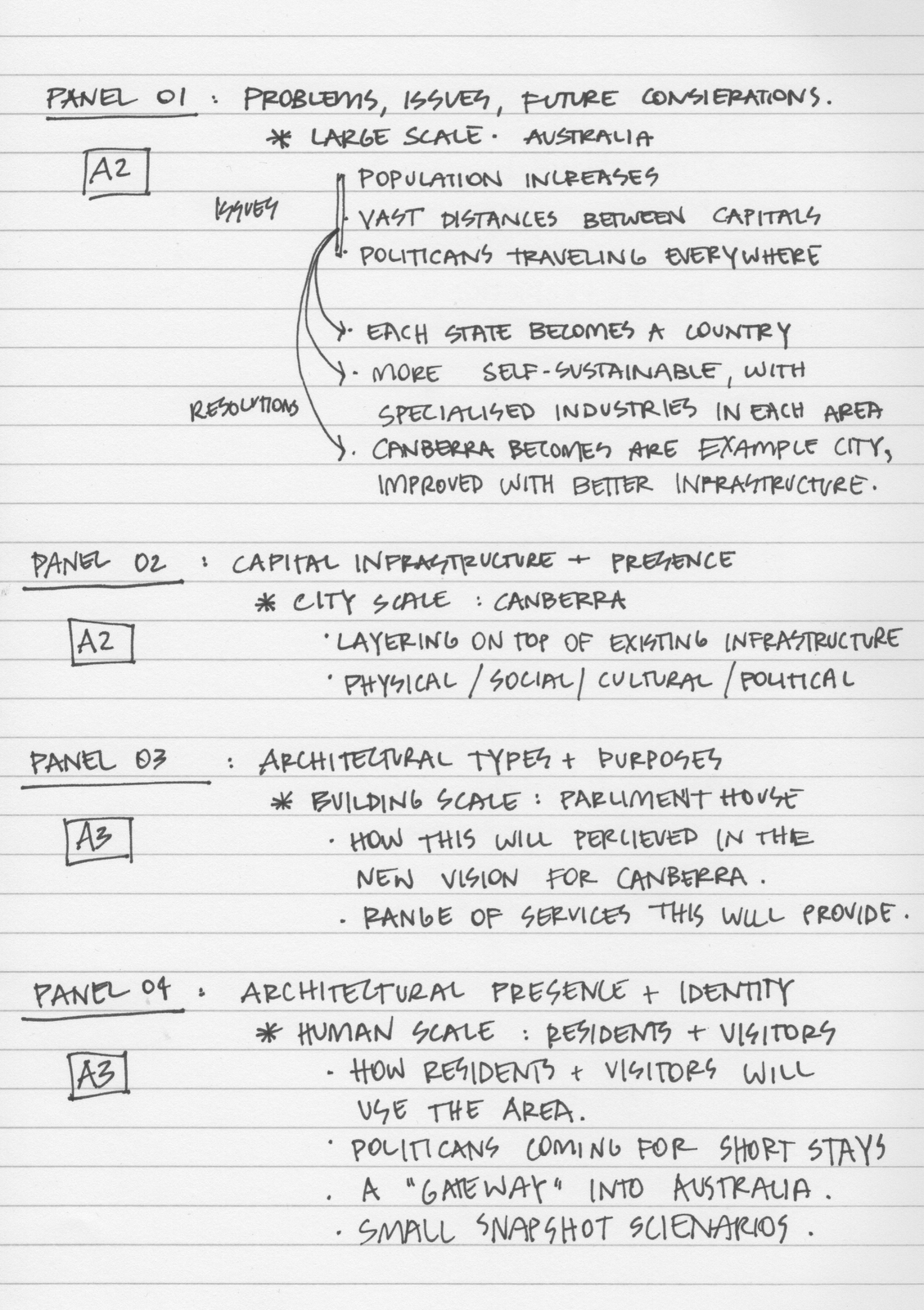
As I've been allocated to complete the graphics required for panel 1, I have developed a little storyboard to keep me on track.

The assessment criteria states:
Capital Strategy (25%) : The panel presented and blog posted satisfies the following descriptions.
Your chosen strategy (flexible, mobile, distributed or virtual) was well investigated.
our idea creatively identified problems and issues associated with ways capital city / parliament worked today in Australia and a speculation was made to suggest your idea could lead to an innovative solution.
You summarised your investigation well and communicated all necessary information clearly and creatively with images and diagrams in your panel.
Your blog communicated your idea development well.
With this in mind, here is a more detailed plan:


Monday, 29 August 2011

05 : Interim : Development

So here is my few changes to the overall outline... I did this while reading the assessment criteria, if we can pull it off in a succinct style I think it will be good..


05 : Interim : Development

This is the draft panel layout by Jess and Dee:

There is a lot of information to be displayed, and I'm wondering if there is a way to simplify this a bit more / if it is possible to add in my idea.  I don't want to over complicate this project too much especially when there is not much time left.  I'll do a bit of a sketch of what the panels might actually look like with this proposal..

I think the best way for this to work is if each of us does one panel - rather than all of us doubling up on the same thing.

Sunday, 28 August 2011

05 : Progress

Brain-wave..... what if Australia was separated into individual countries...
... small distances to manage
... union similar to European Union
... increased densification

only 6 days until presentation... this isn't the best time to have new ideas!!! - but I'll talk to my group about it and see, who knows - maybe it can be incorporated.  This is just a really really rough sketch that I did when I first thought of the idea...

I'll wait and see what the overall plan for the panels is, based on what was discussed in the tutorial and decide if it's worth exploring this idea a little further.

At this stage, I think it's slightly realistic.. and I think that keeping Canberra as a central 'iconic' city.  Each of the other capital cities would be given more power to make decisions that affect it's area.  This allows the Australian Union in Canberra to focus on bigger, wider issues and the overall well-being of the continent.

Sunday, 21 August 2011

04 : Lecture

This on again / off again lecture was eventually taken by Phillip Crowther, and I'm really glad that it was.  Even though it was evident that it was quickly put together, it was still the most rewarding and relevant lecture so far this semester.

We were introduced to a competition called 2040 Glimpses of New York Exhibition.  What I found most interesting is the way the exhibition was split into 5 categories (Breathing / Eating / Making / Moving / Dwelling).  Just this simple categorisation, things seemed to click with our project this semester.

As I am in the 'mobile' tutorial I was particularly interested with the 'moving' category which proposed the Hybrid Urban Base by 'Dland Studio. "The team notes that the water edge at Hunters Point, Queens will be inundated in 40 years. This creates the opportunity to utilize an intertidal canal to create inland ferry access. That makes it possible to propose a new intermodal civic and transport center that synthetically integrates ferry, bus, train, automobile, bicycle and pedestrian circulation. The glimpse image shows the new transportation hub. All of the transportation ‘loose ends’ of Hunters point will be integrated into one transportation hub – the HUB, or Hybrid Urban Base."


I plan on researching some other examples of the future predictions of cities.  I think by seeing what other designers are envisioning it helps bring some perspective on how relevant this project might actually turn out to be.