Showing posts with label research. Show all posts
Tuesday, 1 November 2011
Monday, 31 October 2011
14 : Exemplars
Structural principles such as repetition evoke a sense of movement within a design. I am inspired by the use of materials and spatial arrangements of these projects:
Centre d’Examen du Permis / a+ Samuel Delmas / France |
Puerta Umbría High Speed Rail Station / Rafael de La-Hoz Arquitectos / Spain |
| Infostructure / Manifesto / London |
| Infostructure / Manifesto / London |
| BA_LIK / Vallo Sadovsky Architects / Slovakia |
| BA_LIK / Vallo Sadovsky Architects / Slovakia |
Temporary Hotel / IAA Architects |
Flederhaus / Heri & Salli / Vienna, Austria |
Cadiz Temporary Pavilion / Breathnach Donnellan with EASA Participants / Spain |
Temporary Art Pavillion / 4F-K |
Design Miami Tent / Moorhead & Moorhead / Miami |
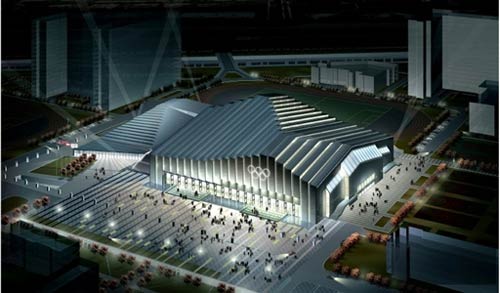
China Agricultural University Gymnasium |
Sunday, 30 October 2011
Thursday, 27 October 2011
Wednesday, 19 October 2011
11 : Exemplar : Station 2
Musée National des Beaux Arts du Québec proposal / Allied Works Architecture
The ground floor is primarily transparent, providing a sense of the
park extending through the building and into the courtyard, where a
grove of Yellow birch provides shade and protection. The garden
pavilion extends the landscape further, with the store and future café
opening onto the courtyard with the entire building covered in planting. The building is a braid that binds the diverse forces of site and program into one calm, beautiful and profound whole. The
new spaces are large enough to be flexible and accommodating, yet
intimate enough to create personal experience with the art. The natural
light is gentle and luminous, providing a sense of connection to nature
and life. There are also moments of repose along the journey, places to
sit and gaze out into the canopy and courtyard.11 : Exemplar : Station 1
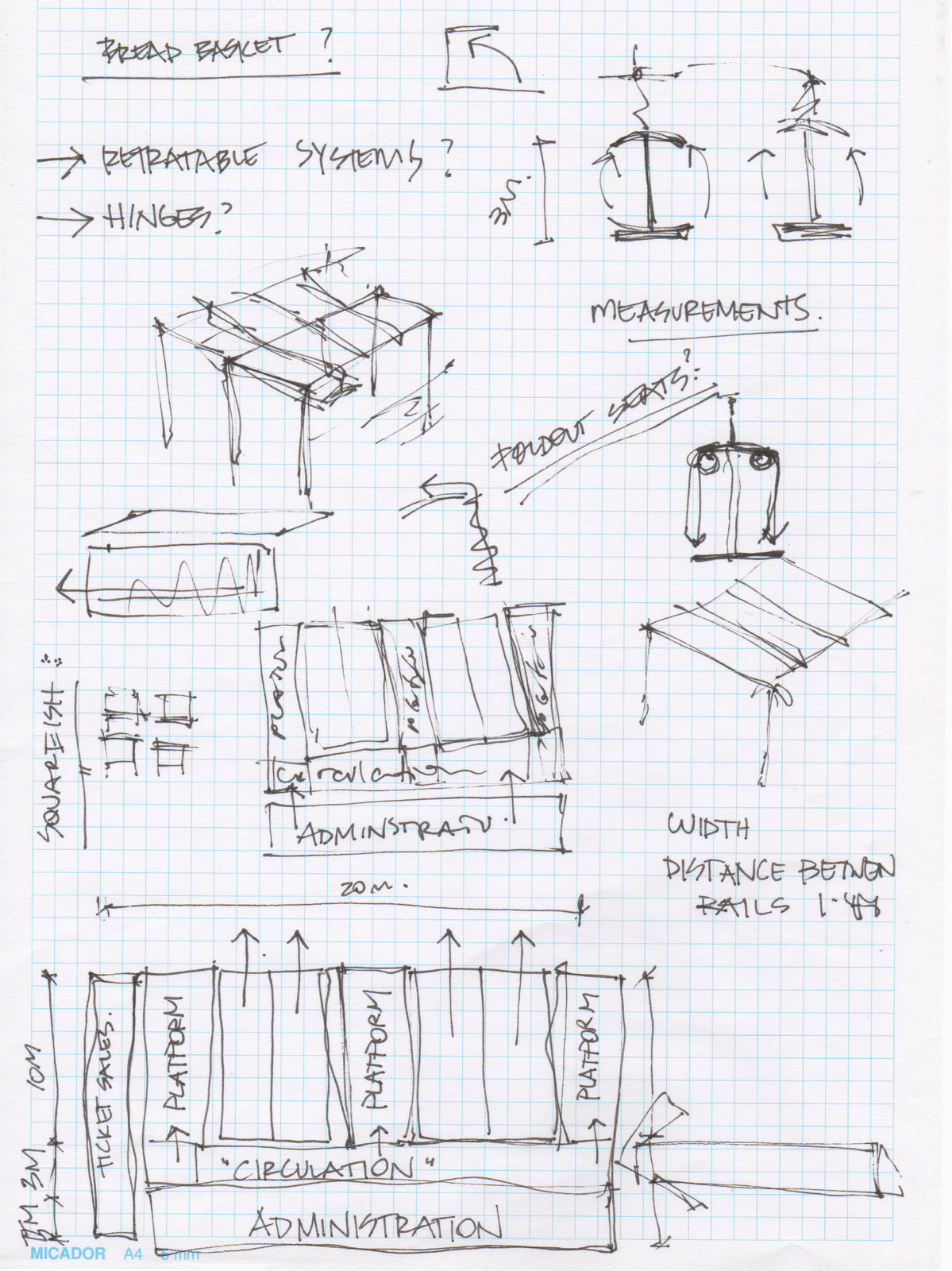
Here is a concept development what was a public building done in close
proximity to a railway line.I think this type of structure / form would
work well, if the train lines were actually running through it... maybe
they stopped in staggered positions??
The forms and spaces of the new MCBA are both monumental and transparent. The building’s geologic form is fractured by activity, providing glimpses into and through the heart of the building. Ideal gallery proportions establish a rhythm of space and structure along the Arts Walk and rail lines. Between galleries, structure, circulation and light form fissures of transparency – filtering and diffusing light into the galleries, providing views to the landscape and city while connecting the building vertically. With a simple juxtaposition and pivot of structure the building becomes alive with light and energy. The new architecture binds the city, landscape and art into one synthetic experience.
Tuesday, 18 October 2011
11 : Exemplar : A New Infrasturcture
Some of my favourite images / projects are displayed below:
1) Glocalizing Los Angeles : The physical separations between places of work and play have become outdated and burdensome. Meanwhile the divide between commercial, residential, agricultural, and manufacturing zones have become so exaggerated that the infrastructures needed to connect and sustain them crumble in lack of upkeep and congestion.
2) Modular Diffusion : In a car, the passenger can go from any given point to another in one continuous trip. To achieve this level of mobility in tandem with an increase in roadway capacity, we introduce a mass transit system based upon a Modular Transit Vehicle (MTV for short). This modular system would allow passengers to (1) board from a wide range of street stops, (2) travel along the freeway, and (3) take the freeway exit closest to the destination drop passengers off there, all in one ride.
3) Interstate 10 :
4)
Monday, 17 October 2011
11 : Research : Train Interior
I stumbled upon this design competition where people proposed future train design concepts.
Here are some of my favourites, which have got me thinking about how the light rail could be designed:
YOYO: What if we think of the interior of a train as a space that is totally open and only a absolute necessary number of seats are placed. An invisible number of seats keep the space as opened and unidvided as possible. What if we think of it as a space where density only depends on the number of the traveling passengers and the seat itself has different capabilities and can do things a fixed rigid structure could not do.
PANOTRAM: The project is an advanced design of anelectric tramway – which I like to call the Panotram. There is a strong need to a tramway that will bring together peoples and their environment.
The uniqueness of the tramway is the combined configurations which include closed internal niches and patios that one enjoys while riding the tramway. The innovation of the Panotram is a new integrated experience in which the passengers enjoy a relaxing ride either in the cabin of the train or outside in its patios.
Here are some of my favourites, which have got me thinking about how the light rail could be designed:
YOYO: What if we think of the interior of a train as a space that is totally open and only a absolute necessary number of seats are placed. An invisible number of seats keep the space as opened and unidvided as possible. What if we think of it as a space where density only depends on the number of the traveling passengers and the seat itself has different capabilities and can do things a fixed rigid structure could not do.
PANOTRAM: The project is an advanced design of anelectric tramway – which I like to call the Panotram. There is a strong need to a tramway that will bring together peoples and their environment.
The uniqueness of the tramway is the combined configurations which include closed internal niches and patios that one enjoys while riding the tramway. The innovation of the Panotram is a new integrated experience in which the passengers enjoy a relaxing ride either in the cabin of the train or outside in its patios.
Monday, 10 October 2011
10 : Development : Maps
Using the data in the research article (which was originally complied in SEIFA) I have developed mappings which show the suburbs which are considered to be generally deprived.
These maps illustrate that the most deprived areas are Acton and Charnwood which are both located North of Lake Burley Griffin. Acton is covered mostly by the Australian National University which may explain is low rating. Charnwood is located in the Belconnen district, and was designed using the Radburn town planning principle (houses face a common parkland) which failed due to residents building fences
There is also high density of the band 3 deprivation in the southern district of Tuggeranong. It is the second largest district outside of Canberra, and is considered a 'growth area' in terms of its new facilities such as the large Tuggeranong Shopping Centre, Arts Centre and the Town Centre.
I will use this information to develop a possible route from the Northern Districts, to the Southern Districts... of course, keeping in mind the existing infrastructure in each area.
Subscribe to:
Comments (Atom)