Showing posts with label politics. Show all posts

Wednesday, 26 October 2011

12 : Exemplar : Mobile Parliament

Look what popped up on my archdaily newsletter this morning.... "Mob-ile Parliament" is a project by Melbourne-based Andrew Maynard Architects.  Here is the description,

A mobile, adaptable architecture is a democratic architecture. Democracy is a weird creature. An illusion of choice. An illusion that those in power are truly answerable to the masses. Many of the spaces that elected representatives occupy are heavily controlled, fortified and spatially manipulated to the benefit of the representative rather than those represented. The disenfranchised, those left out, those left behind, those completely disempowered have only one way to make themselves heard; forced to embrace mobility and guerrilla style hit-and-run tactics. The letter to the editor can be ignored. The push, or the shove, cannot. In frustration many choose to express their dissatisfaction and disillusion physically rather than through rational argument. Many aren't even afforded the right to be heard. The security and safety of elected representatives is undeniably important, as it is with all constituents. So how do we allow the will of the people to manipulate parliamentary space to express dissatisfaction with, or celebration of, their representatives? How do we allow them to be seen and to contribute to physical/spatial change, even if only symbolically? If mobility and hit-and-run guerrilla tactics empower the disempowered and marginalised, if only momentarily, then perhaps a truly democratic parliament is one that responds spatially to the will of the people. Perhaps a parliament can be both fortified and open to attack. What if parliament could be manipulated by the masses? What if parliament's spatial condition is changeable by those that are dissatisfied and marginalised as well as those that are pleased with the contributions of elected representatives? The abrupt, confrontational nature of direct physical interaction is what drives the Mobile Parliament. Though safe within, the politician’s access to view and light can be democratically controlled by the public.

Pretty inspiring idea and graphics I think -- I wish I stumbled upon this earlier!

Friday, 14 October 2011

10 : Reflection

Even though I still have a lot to do, I am feeling a little more confident.  I did at least one thing everyday this week, which kept my mind thinking about the project, which deterred me from getting distracted.  I still would like to do a big 24 hour needs-analysis of the dedicated train route in a similar style of what I did for a project last year - I think I will ask Jane, if it is worth me spending the time.


My parliamentary justification so far is:
Realistically, politicians will probably not need to travel to Canberra for parliament as often, mostly due to technology advancements - so I will focus on servicing the people of Canberra, the greatest good for the greatest number of people -- (Jeremy Bentham, Enlightenment Principle)

Tuesday, 27 September 2011

09 : Research : Time-Based Architecture

Following on from the reading, here are a few exemplars of time-based Architecture:

Cedric Price Potteries Thinkbelt Project (1964) - This theoretical project was a reaction against the elitist university institutions (which Price believed kept education separate from the masses) and the loss of skilled manufacturing workers/developers through the ‘Brain Drain’ and de-industrialisation of the post-war UK. Price proposed a new type of science and technology teaching institution. The ‘Potteries thinkbelt’ was a series of interconnected faculties and student housing which was linked through the existing road and rail networks (which were underused at the time). The Rail connections not only acted as a link between sites but also acted a teaching rooms, labs and workshops. This was achieved by having container styled teaching units which could be lifted by cranes at ‘transfer’ area onto or on a train depending on the requirements of the institution. Price believed that the creation of such an institution would create employment and innovation in the area and thus aid a better quality of life in the North Staordshire Area.

Archigram 'Walking City' proposed building massive mobile robotic structures, with their own intelligence, that could freely roam the world, moving to wherever their resources or manufacturing abilities were needed. Various walking cities could interconnect with each other to form larger 'walking metropolises' when needed, and then disperse when their concentrated power was no longer necessary. Individual buildings or structures could also be mobile, moving wherever their owner wanted or needs dictated.


These are both theoretical examples, but they still provide a great source of inspiration.

Thursday, 8 September 2011

06 : Research

I'm looking forward to having a bit of a chat to Jane about which direction to take for the rest of the semester.

One idea I had was to focus on the integration of 'Russell' into the master plan, as with our new transport plan this would be the 'gateway' into Canberra, the first glimpse into the axis of the city.

Russell is one of the smallest suburbs in Canberra, comprising a number of government offices but no private residences. It is probably best known for the headquarters of the Australian Defence Force, which is housed in the Russell Offices complex. 

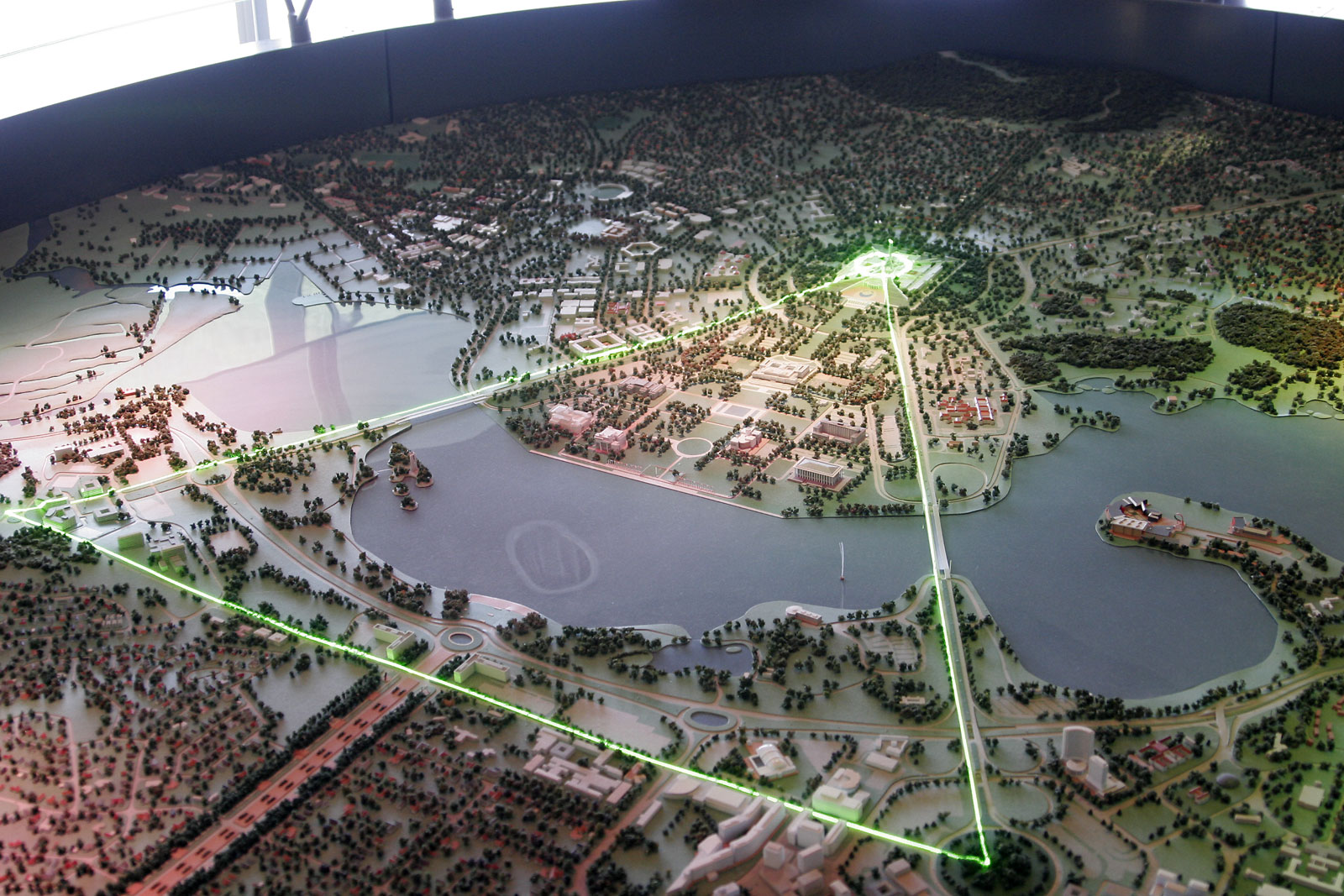
The Parliamentary Triangle is the ceremonial precinct of Canberra, containing some of Australia's most significant buildings. The triangle is formed by Commonwealth, Kings and Constitution avenues.


Russell Offices complex comprise the Office of National Assessments and Australian Security Intelligence Organisation, as well as the Department of Defense and Australian National Defense Force.
View of Campbell Park, headquarters of the Australian National Defense Force.

From the book 'Canberra Following Griffin' the diagram illustrates a study for National Capital Authority, about the 'Central National Area' completing the Constitution Avenue restoring the Russell corner of the triangle as the new entry to the city.
The Australian–American Memorial commemorates the role of the United States in World War II. 

Monday, 22 August 2011

04 : Tutorial

In tutorial we finally got allocated to our groups... I'm with Jess http://jess-hammond.blogspot.com/ and Dee http://gnel-datie.blogspot.com/

The diagram below shows a bit of a process of the types of things discussed in the tutorial.


We also began to figure out what is actually required for the panels.... not sure if we are on the right track yet, but this is a vague outline of our 'plan of attack' for the presentation in less than two weeks!!


Some of the references and websites we used throughout our discussions this week:
"Imagining a world without flight"
http://www.walrusmagazine.com/articles/2008.07-travel-grounded-travel-by-air-david-beers/

Site for diagramming techniques:
http://infranetlab.org/blog/

"A Mobile Utopian House"
http://archinect.com/news/article/17081468/a-mobile-utopian-house

Tuesday, 9 August 2011

02 : Tutorial : Mobile

This weeks tutorial allowed for exploration in groups about of the four different themes (Virtual / Flexible / Mobile / Distributed) and how they benefit an Australian Capital and its agents.  Naturally, some were easier to explore than others.


In this tutorial, I felt that the tutors gave us much more direction.  Questions raised were about what are the benefits of the forum? How will decisions be made? Will parliament exist as it does now?  As mobile is defined as something with the capability of moving or being moved, I think this will relate to how information is store and recorded.  People have a wider, and easier, access to information in a variety of formats, and so the way in which parliament will exist has to adapt to these changes.

This reminds me of a speech by ABC journalist Kevin O'Brien about 'Politics and Journalism'.  He says that "in an age that desperately needs enlightened leadership, the disproportionate size of today’s public relations industry is causing an alarming decline in the quality of public discourse."  In O’Brien’s view, as a result the combination of the problems on either side, there are so many issues that are not given the time and space they need, to be adequately debated. O’Brien maintains that people who are time-poor and preoccupied with their own struggles must, obviously, rely on the mainstream media to find out what’s going on. “If they’re not being well served by that part of the media they go to, either they will not trust it, end up poorly informed or worse, mislead.”

Although it is not architecturally related, it's interesting to see how the future of politics and increasing technologies are so closely related.  The full speech can be found here: http://tv.unsw.edu.au/video/wallace-wurth-memorial-lecture-2011-kerry-o-brien